The seventh-day Shabbat (Sabbath) is not only central to Israel’s calendar, it is at the heart of Jewish identity. Exodus 31:13 reports Adonai commanding Moshe to “speak to the sons of Israel, saying, ‘Surely, My Shabbats you must guard, for it is a sign between Me and you, to your generations, to know that I, Adonai, am sanctifying you….’” Yet the observance of Shabbat has historically been shrouded in rules and customs that can separate us from the very Shabbat we are supposed to be protecting. Beautiful, elegant—some-times strict—and infused with spiritual symbolism, the Shabbat traditions of Judaism nevertheless (and unnecessarily) complicate what may arguably be the simplest thing in Scripture.
While the practical out-working of Shabbat in the modern Diaspora does take some amount of forethought, the principles set forth in the Scriptures are easy to understand and apply—if we will only hear them. Indeed, wedged in our thinking is the belief that Jewish religion and culture supercede Scripture, and that centuries of practice amount to expertise. Not necessarily.
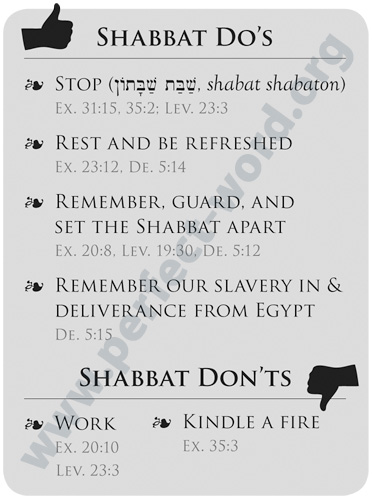
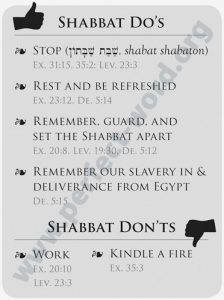
“How do I ‘do’ Shabbat?” is the question that kills Shabbat even before it begins. Candle-lighting, Shabbat dinner and special prayers are nice, but not what this holy day is all about. To “do” Shabbat, first consider the Scriptures (see image, above), and start by simply stopping. Don’t worry about going wrong with the way you “do” Shabbat… as long as you’re not going at all…
What do you think? Post a comment below.
This “Fast Foundations” article was originally published in Messianic Jewish Issues.
(Other extra-Torah or land-dependent Shabbat prohibitions include carrying a load out of one’s house or in through the gates of Jerusalem (Jer. 17:21-22), and buying from non-Israelites who are trying to do business in Jerusalem (Neh. 10:31, cf. 13:16). There are also explicit commands for Shabbat sacrifices. As for assembling for the purpose of worship, the Shabbat itself is a sacred assembly (Lev. 23:3), but what constitutes assembly, where, and of whom is not stated. Assembly of at least some members of Israel at the Tabernacle/Temple may be implied by Numbers 10:2&10.)