As Messianics on a quest for self-definition and the recharacterization of our faith, perhaps the most fundamental, core issue we face is that we too quickly and easily revert to religion, mistaking it for a tangible relationship with God. As such, when we demonstrate the fortitude to reject a given religion (i.e. Christianity, Judaism, etc.) in pursuit of a “true faith,” we find ourselves believing that whatever road we feel led to travel next (i.e. “Messianic Judaism,” Hebraic roots, et al) must therefore be the way to get to Him. This might be true, except for the fact that many of us have issues with shedding our religious tendencies, and more often than not, end up simply exchanging one brand of religion for another. Read more
Articles & Answers
Q: Dear Kevin, my identity is in Yeshua, and this identity connects me to Israel. I am not Jewish by birth, but I am an heir to the seed of Avraham. So, as a Messianic Believer, should I convert?? Personally, I feel I should, but am seeking guidance on the matter. Shalom Read more
“So Paul stood in the midst of the Areopagus and said, ‘Men of Athens, I observe that you are very religious in all respects. For while I was passing through and examining the objects of your worship, I also found an altar with this inscription, “TO AN UNKNOWN GOD.” Therefore what you worship in ignorance, this I proclaim to you.’” Acts 17:22-23 (NAS)
Most religions have their fair share of religious objects, icons and artifacts—and Judaism is no exception. Though some may consider the tabernacle elements such as the ark, the menorah, and the altar to be sacred symbols to all Israel, the ceremonial use of these articles was restricted to the priesthood, which more than likely limited their emblematic stature among the populace. Rather, it is the religious objects of later Judaism—both Scripture-based and contrived—that have become standardized icons to the Jewish people: the star of David, kippah, tallit, chanukiyah (the Chanukah “menorah”), torah scrolls, phylacteries and fringes. Read more
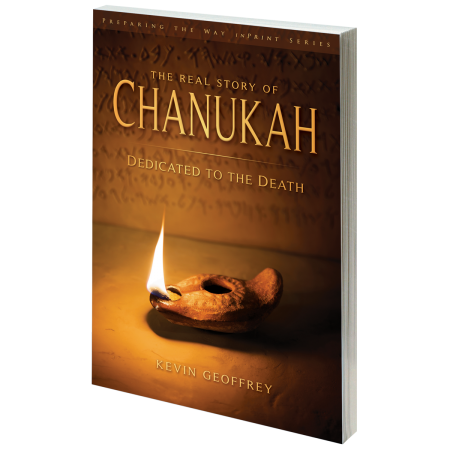
When I was a boy, one of the only Jewish holidays my family celebrated was Chanukah (the other was Passover), but if you had told me that one day I would write an entire book about the Festival of Lights, I would have said you were a couple of candles short of a menorah! Now all these years later, I’m delighted about the newly released “Real Story of Chanukah,” because it truly puts the modern holiday in perspective by placing it against the backdrop of its factual history.
But what really excites me about the new book is that its message is so Messianic… not because it shows you Yeshua in the chanukiyyah, but because the real story of Chanukah is about being completely sold-out, zealous, crazy-on-fire—dedicated—to Adonai. I love this kind of message!
In The Real Story of Chanukah (which quotes at length from the apocryphal, yet historically reliable books of 1&2 Maccabees), we get to witness the struggles of a handful of average, everyday Jewish people during the intertestamental period. Against the overwhelming anti-Semitic and assimilating forces of their day, we see these valiant, devout few as they fight for the God and the Torah they love, in order to restore Israel to faithful fellowship with God. The story is just incredible—it’s vivid, moving, and, at times, almost beyond belief. And it’s within this context that I was able to unpack the Messianic message, illustrating how, according to the Scriptures, we too can and must be completely dedicated to the cause of Yeshua.
The following is adapted from the introduction to the inaugural edition of Messianic Jewish Issues.
Let’s face it: we all have issues—some of us more than others—and the sooner we admit it, the better! Of course, I am poking fun at the title of our new publication, Messianic Jewish Issues, which was deliberately named for its double meaning. Indeed, we all trip and stumble in our walk with Yeshua, primarily because of our own issues. But we also have legitimate questions about living the Messianic Life, and we need clarity and direction if we are to be effective people of God. Messianic Jewish Issues exists, then, for this very purpose: to begin to deal with the issues that affect us as disciples of Messiah in and around the enigma that is the Messianic Jewish Movement… and to do it with the same Scriptural integrity and honest exhortation that Perfect Word has always endeavored to employ. Read more
Q: Dear Kevin, an old friend of mine discovered that he and his family were actually descended from Jewish bloodlines, and he dropped out of the Gentile churches and became a Messianic Jew. He suggested that I myself may also be descended from Jewish roots. In fact, he seems convinced that I am, based upon the calling and anointing that he sees in my life. I prayed about this issue, then slowly but surely, the “Jewish-magnet” began pulling on my heart. I would not want to pretend or assume to be something or somebody that I am not. But if I am, in fact, Jewish, and not Gentile, then I would be honored and rejoice with great joy! What would you suggest that I do at this point? Read more

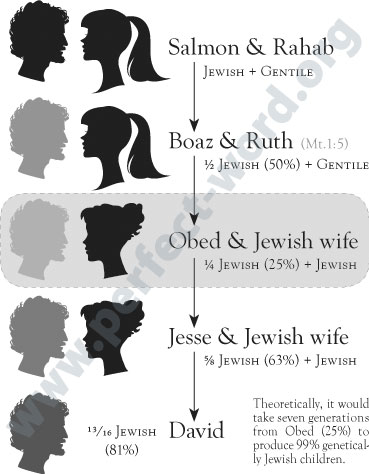
Why is this important? For Jews whose heritage has been obscured from them, it aids in the restoration of their birthright as sons or daughters of Israel. For Gentile believers in Yeshua who may otherwise be tempted to covet Jewishness (see “Am I Really a Gentile?”), it helps to affirm their birthright as the recipients of the blessings of Israel (Genesis 12:1-3), and keeps them strong in their identity as fellow-citizens with Jewish believers in the Household of God (Ephesians 2:19).
This “Fast Foundations” article was originally published in Messianic Jewish Issues.
Please believe I am not bragging when I say that for many years now, people from all over the world have found the Messianic devotionals I have written to be helpful and inspiring for their daily walk in Yeshua. I give all glory and praise to Adonai for this, because whatever encouragement or insight I have to offer, it is only because I have gained it (usually the hard way!) by His loving and compassionate hand.
Yet, I mention this not to call attention to myself or the character of the devotionals, but to point out the fact that we as believers in Yeshua primarily seek information and inspiration for one purpose: self-edification. While I am personally pleased that my writings have been edifying for so many, the purpose of the devotionals (as well as everything produced through Perfect Word) has never been for self-edification, but always for discipleship—the means by which we first become edified, then multiply that edification by passing it on to others. This, however, is not the way most of us approach a “devotional” or any other kind of spiritual experience—rather, it is generally with the intent to focus ourselves on the Master and increase our devotion to Him.
Such goals are in no way wrong. On the contrary, in a world that is constantly trying to steal our focus away from God, we need to use every means possible to keep our hearts and minds dedicated and devoted to Him. Where we do go wrong, however, is that we tend to stop there, feeding only ourselves, and forgetting the most important reason to increase our own devotion: everyone else. Indeed, the walk we walk in Messiah is ultimately not for our own benefit; rather, “Let no one seek [good for] himself, but each [one for] another’s.” (1Co. 10:24) Read more
It’s what everyone all over the world isn’t saying today… and why should they? After all, it’s the middle of March, and nothing around us offers even a hint that a new year has begun. Indeed, most of us haven’t even a clue that a new month has arrived (“Rosh Chodesh,” or New Moon), much less the renewal of an entire year!
Nevertheless, it’s true—the New Year is here… the New Year for Israel, that is (Exodus 12:2, “This month is to you the chief of months—it is the first to you of the months of the year.”). And yet, even world-wide Jewry doesn’t have New Year’s on its collective radar right now. No, for us, New Year’s doesn’t come around for another six long months (“Rosh HaShanah”)—or so we’ve been led to believe.
“Who cares? What’s the big deal?” you retort. “Scripture doesn’t even say that the first New Moon is to be honored any differently than the others (except the seventh)!” Indeed, why does it matter that most of “civilized” planet earth calls a random moment in time—January 1st—“New Year’s Day”? And why get all worked up just because Judaism celebrates its New Year in the Fall, instead of observing it in the Spring, according to the Scriptures?
I would like to share a recent exchange I had with one of our enews subscribers who questioned the manner in which we determined the date of Passover this year. A little background for those of you unfamiliar with the nature of the debate: it centers on the reliability of the established Jewish Calendar versus the observation of the phases of the moon, the sun and the agricultural state of the Land of Israel as opposing systems for accurately determining the dates of Israel’s calendar. This is an important issue because the dates of the calendar practically affect when to celebrate the year’s annual appointed times, such as Passover.
Our enews letter read in bold letters: “Only 2 weeks to Passover!”
Our subscriber replied, Read more